Project metrics: what moved, week by week
Name: ratified 2026-09-02 (calef, moving it from design/). He proposed it as
design/project-metrics.md and moved it here on the argument that design/ holds arguments
(design/fatal-risks/README.md, the decisions, the roadmap) while notes/ holds what was measured
(benchmarks.md, mutation-testing.md, unsafe-obligations.md). script/metrics and the
directory notes/project-metrics/ are provisional; naming is an architect's, and a lane ships a
provisional name and says so.
One row per ISO week, computed by script/metrics from git history. The data is one CSV per
measure in notes/project-metrics/ (in nifeos/nife), versioned with the code it describes. The
charts are SVGs beside the data, and this page draws each one from nifeos/nife's main branch.
This page is a deck (calef, 2026-09-24). A chart is a heading, an image, and at most a line or
two saying what it plots and what would otherwise be misread. Everything longer, the definitions,
the arguments behind a measure, the deadlines, the reconciliations and the dated analyses, lives in
notes/register-of-measures.md, whose The weekly series table routes
each chart to the appendix that argues it. That register is the half of the pair that does not change, and a caveat that cannot survive one
line belongs there, not in a caption.
Read this before you read a number
- Every row is a restatement, not a report. The series applies today's definitions to old commits, which is right for a trend and is not what anybody believed at the time.
- Every figure here is derived by an agent and none of it is externally audited. Where a number has been checked two different ways, the register says so and names the method.
- A missing bar means the record did not exist, not that the number was zero.
- Weeks are ISO weeks in UTC, spelled
2026W36everywhere, and the series starts at 2026W29 because that is where the first commit falls. There is no 2026W28. - The charts show the last 13 weeks; the CSV keeps every one.
- A milestone is not a fixed unit and a pull request is not a unit of value: read the shape.
The nine things that would kill nife
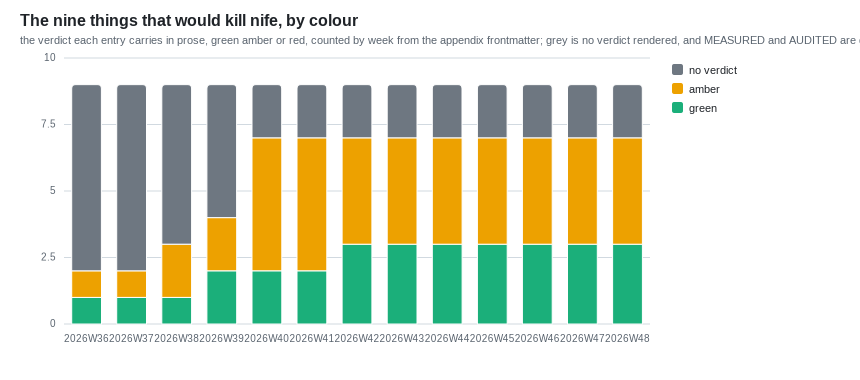
- 2026W41: risk 4 went green on 2026-10-05 UTC (calef); milestones 761 and 766 cut the null system call's growth to four tasks from 48 to 10 ticks.
Names by what the tree records about them
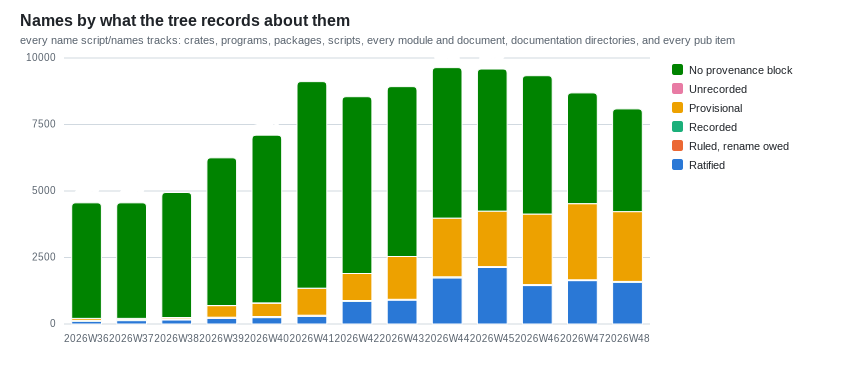
- 2026W42: the total fell from 9,111 in 2026W41 to 8,544. Pull requests #2353 (merged 2026-10-18 20:26 UTC) and #2375 (21:58 UTC) narrowed
pubitems no package reads topub(crate), taking 884 and 411 names out of the no-provenance-block band. The rest of the week added 728. No name was lost; the narrowed items are no longer counted.
What each name's own provenance block says, for every name script/names tracks: crates,
programs, packages, scripts, every module (each .rs file under a src/ directory), every
documentation directory and document, and every pub item. An item is a function, method,
constant, static, type or trait. A name a rule covers counts as ratified. Ruled, rename owed is a provisional
name calef has ruled whose rename has not landed. No provenance block is named things with no
readable block. Every kind is counted from the tree, so writing a block moves a name out of that
band without changing the bar's height. The current week's total is checked against
script/names. A week is a bar, so a day's rulings show as the current week's bar moving. A rising
Provisional band is not debt; the band worth an alarm is Unrecorded.
unsafe blocks outside kernel/src/arch/
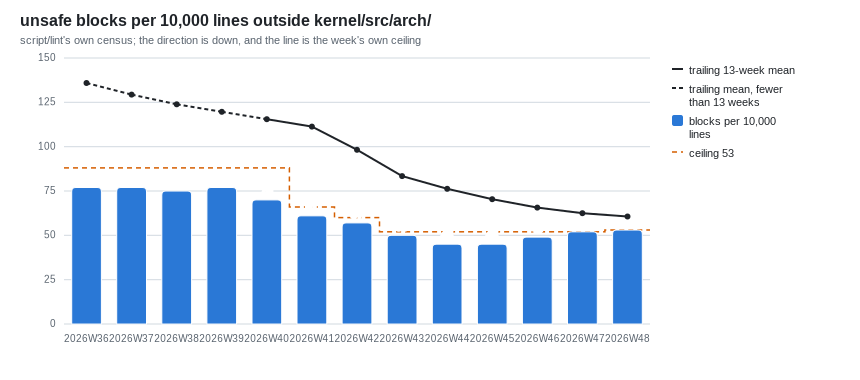
Blocks per 10,000 code lines outside kernel/src/arch/, script/lint's gated census; the orange
line is the ceiling its marker held that week, the other the trailing 13-week mean. Only the ratio
is about soundness.
The same unsafe blocks, by trust boundary
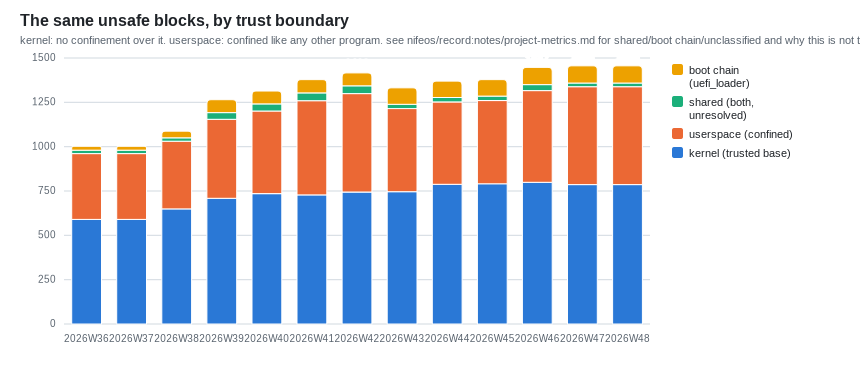
- 2026W41: userspace rose 466 to 531. Of those, 29 blocks are c_library and jig, which landed this week; they were in the census and in no band until pull request #2482 (2026-10-20 UTC) placed them.
- 2026W43: every week here was restated on 2026-10-20 UTC by pull request #2482, which generates the crate table from cargo metadata. The unclassified band (60, 39 and 28 in 2026W41 to 2026W43) moved into userspace and shared, and no week's total fell.
The census split by what confines the code: kernel privilege, userspace confinement, both, and
the pre-kernel boot chain. Every week applies today's crate table, generated from cargo metadata,
so a crate is counted on its current side throughout.
Debt paydown
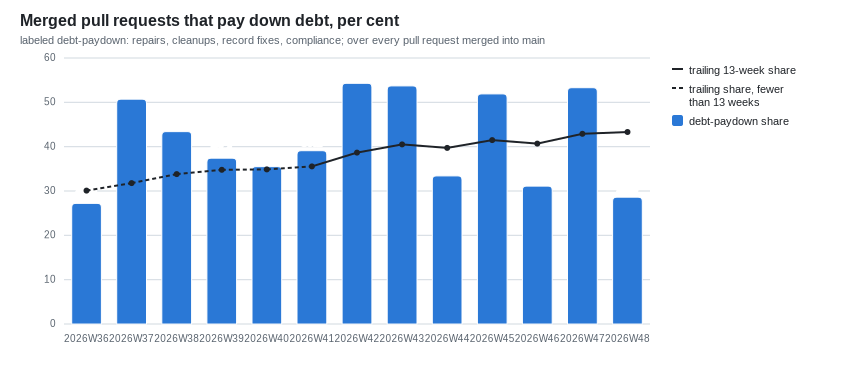
The share of each week's merged pull requests labeled debt-paydown (what
counts). The label is chosen at the claim and judged from titles, so a lane that
became a repair is missed.
Milestones built each week
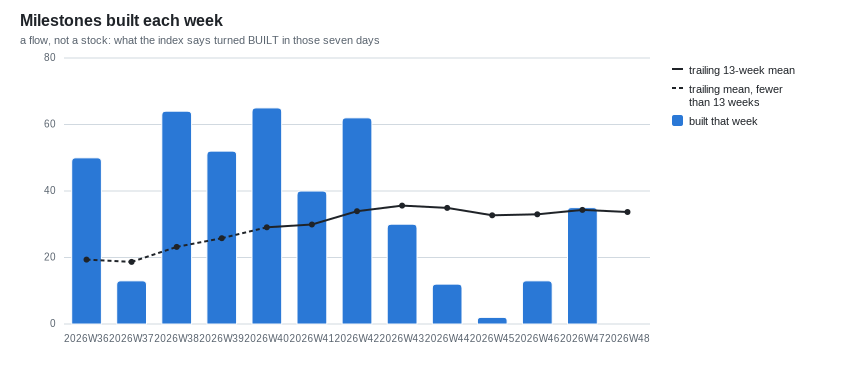
A flow: milestones whose Built: date falls in that week, read from today's tree for every week.
It does not reconcile with the Built stock (BUGS).
The line is the trailing 13-week mean, drawn rather than stored; it is dashed where fewer than 13
weeks exist behind it.
Pull requests merged each week
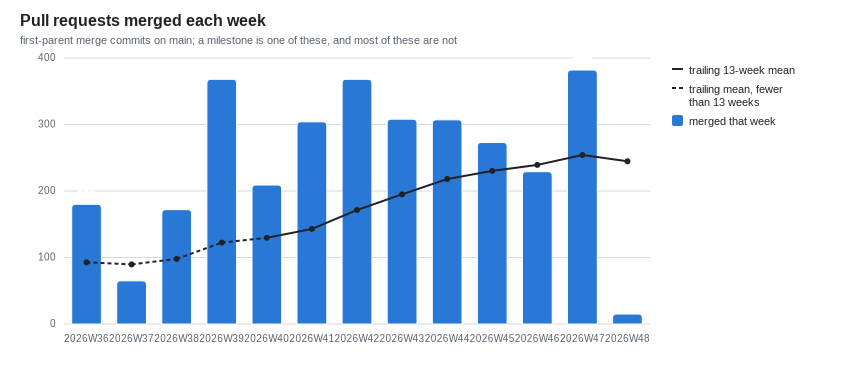
The second flow, counted from main's merge subjects rather than the API, so it backfills to the first commit. 2026W29 and 2026W30 are zeros: the practice starts in
2026W31.
The line is the same trailing mean.
Merge queue ejections
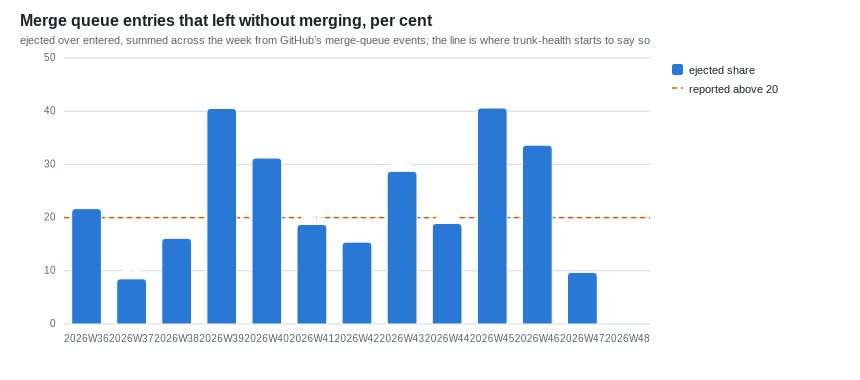
Queue began 2026-08-15; W31 and W32 predate it.
How long a hosted job waits for a runner
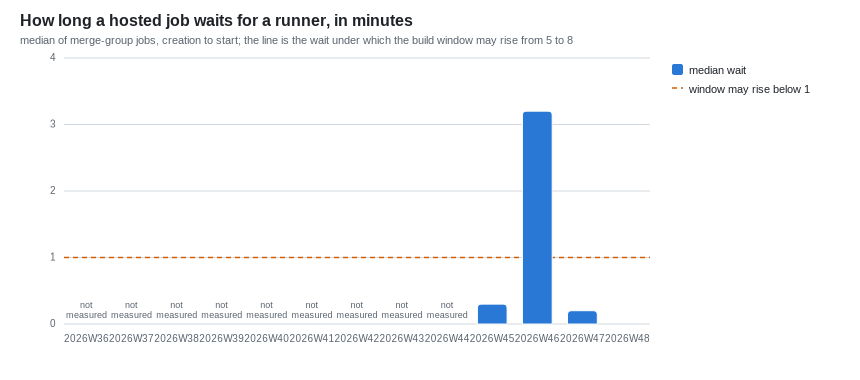
The weekly median of the time between a hosted job's creation and its start, over the jobs of every
ci.yml and verify.yml merge-group run, from the Actions API (helpers/ci_job_times.py;
milestone 1042 (a queue sized to the runner pool)). The count skips skipped jobs and jobs on an
owned runner. The record keeps one median a day, so a week's median is the days' medians weighted by
their job counts, an approximation. The share of jobs that waited over five minutes is in
ci_wait_over_5_pct of the ci-job-waits measure file. The line at one minute is the wait under which the queue's build window may rise
from 5 to 8 (the queue's own settings). The record starts on 2026-11-02 (UTC).
How long a merge-group build takes
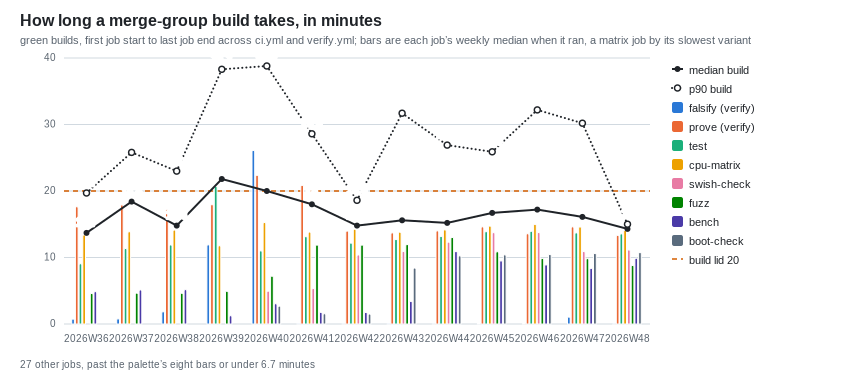
- 2026W41: prove shards rebalanced on 2026-10-07 UTC by a 40-run median and split three ways (calef, #1802), planned at 15.7 minutes each from 20.5 and 27
- 2026W41: CI job test ran at 89% of its budget on its newest merge-group run; tracking issue #1930
- 2026W42: re-falsify replays two records at a time (#1979); full-scope shards fell from 16.5 to 8.8 minutes
- 2026W42: CI job cpu-matrix-shard ran at 86% of its budget on its newest merge-group run; tracking issue #2055
- 2026W43: CI job cpu-matrix-shard ran at 90% of its budget on its newest merge-group run; tracking issue #2451
- 2026W45: CI job fuzz ran at 92% of its budget on its newest merge-group run; tracking issue #3081
- 2026W45: CI job prove ran at 94% of its budget on its newest merge-group run; tracking issue #3350
- 2026W46: CI job prove ran at 96% of its budget on its newest merge-group run; tracking issue #3546
- 2026W47: CI job swish-check ran at 87% of its budget on its newest merge-group run; tracking issue #3651
- 2026W47: CI job swish-check ran at 87% of its budget on its newest merge-group run; tracking issue #3681
- 2026W47: CI job prove ran at 109% of its budget on its newest merge-group run; tracking issue #3713
- 2026W47: CI job prove ran at 88% of its budget on its newest merge-group run; tracking issue #3763
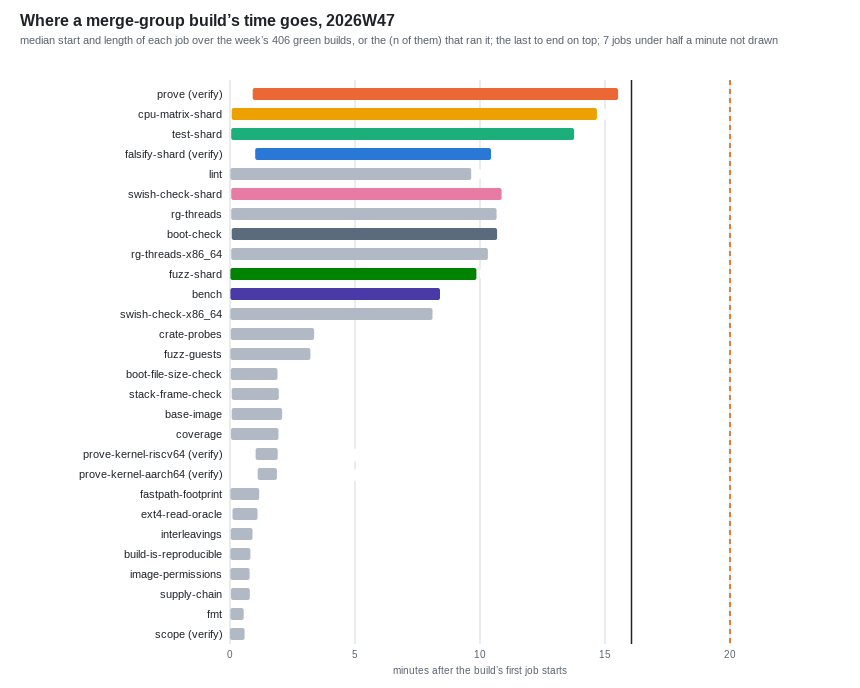
A build is a merge commit's ci.yml and verify.yml runs (same head_sha), first job start to
last job end, green only, from 2026-08-15 (helpers/ci_job_times.py). The timeline is the newest full
week.
Which model wrote it
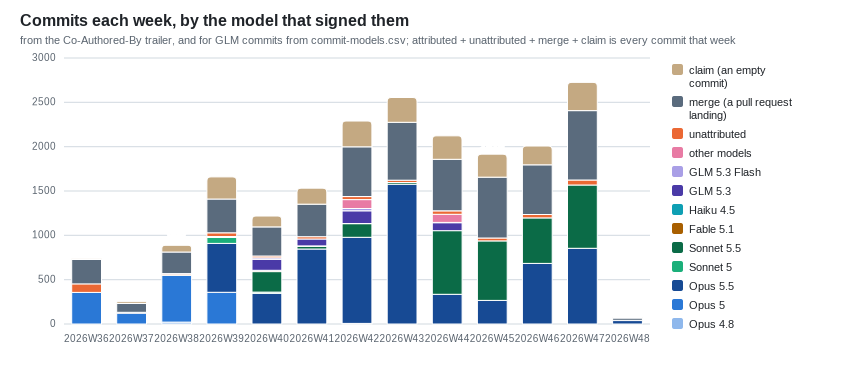
From the Co-Authored-By trailer. Attributed plus unattributed plus merge is every commit that
week; a merge is a pull request landing, not writing. 2026W29 predates
the convention, so it is absent rather than zero.
Only Claude Code writes the trailer, so the table counts one vendor. From 2026-09-29 02:33
to 2026-10-01 05:07 UTC the work ran on z.ai's glm-5.3 under opencode, and its 154 commits read
here as unattributed rather than as a model
(the correction). script/effort has the same gap and its
charts show that week's z.ai work as nothing at all.
"Other models" is a trailer the script does not recognize.
Lines touched, by the model that signed them
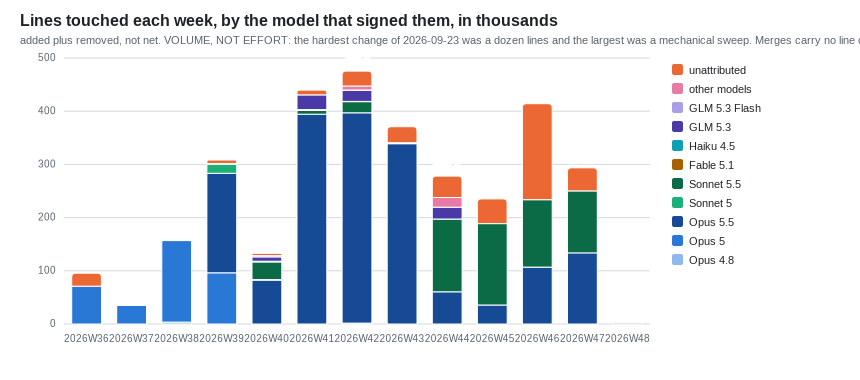
Added plus removed, not net; volume, not effort. Merges count no lines.
What a turn costs
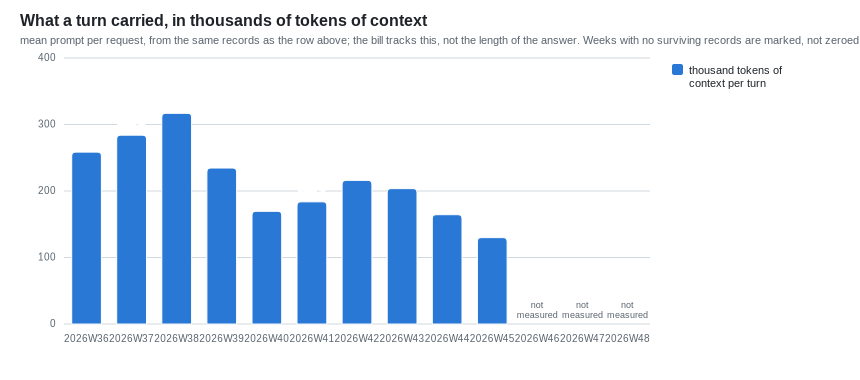
Mean prompt per request, from session records that are not in git. A turn costs the size of its context: cache reads are about 98% of every token spent. 2026W29 through 2026W33 are absent, not zero.
Milestones by status
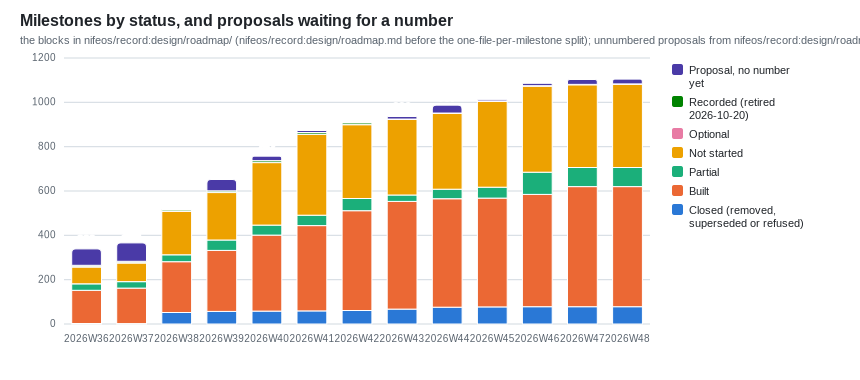
- 2026W43: the Recorded band fell from 7 to 0: calef retired the status on 2026-10-20 (#2467). 52 moved to Not started, 39 to Closed (replaced by a later milestone), 224, 199 and 244 to Closed (refused), and 263 and 626 to Built.
From the milestone blocks in design/roadmap/, with unnumbered proposals stacked on top as the
eighth series: work identified and not yet entered into the roadmap, which unlike a provisional name
is closer to debt. REMOVED, SUPERSEDED and REFUSED share one band; milestones.csv keeps
them apart. A bar counts numbered milestones, so it is lower than the highest number (some were
never used) and than a listing of design/roadmap/, which also holds directories of milestone
parts. The two zero weeks are a restatement artifact; watch NOT-STARTED, which grows faster than lanes
drain it.
Rust in the tree
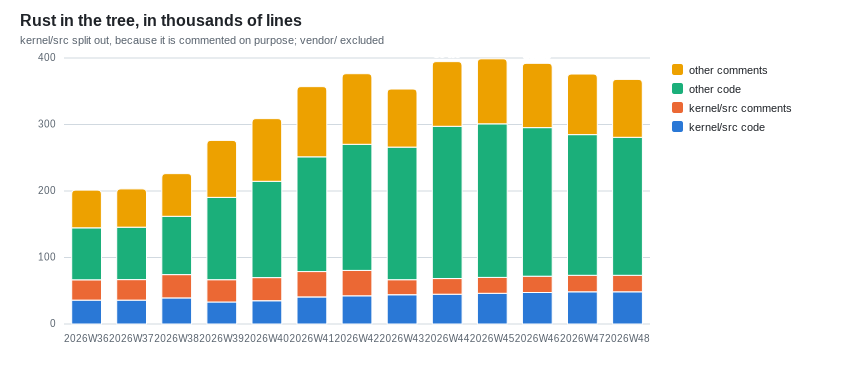
- 2026W40: the kernel code series fell 46,665 to 33,192 lines because milestone 609 (the system tests leave the kernel crate), pull request #1404, moved 66 test-only files unchanged into the system_tests crate; no code was deleted
Every tracked .rs file outside vendor/, with kernel/src split from the rest, in thousands of lines (volume, not effort). A line with code and a trailing comment counts as code.
BUGS sections
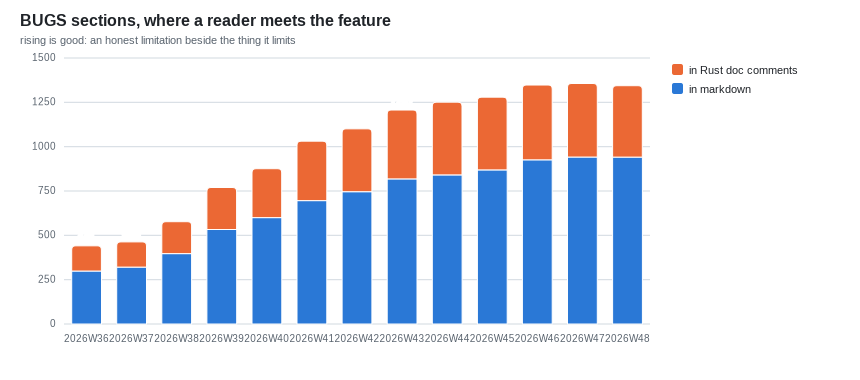
Markdown headings plus Rust doc comments. Rising is good: a BUGS section is a limitation written next to the feature it limits.
Coverage
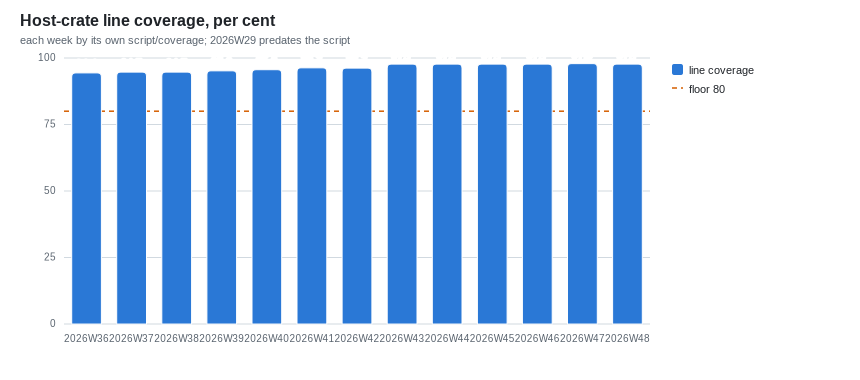
Line coverage, each week measured by its own tree's script/coverage on its own pinned nightly, so
this is the one series on the page that is not a restatement. Weeks 2026W30 to 2026W38 were
backfilled that way on 2026-09-19. 2026W29 is empty because no instrument existed yet; the dashed line is the per-file floor script/coverage gates on, drawn for scale.
The lowest-covered file
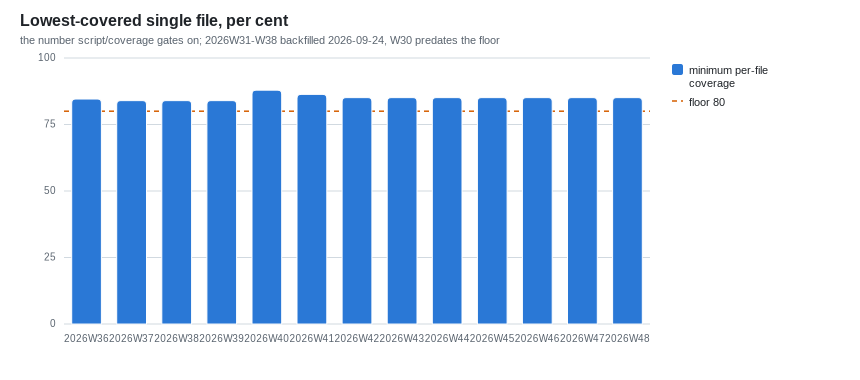
The minimum per-file coverage, which is the number script/coverage actually gates on at 80%.
The aggregate can hold steady while one file slides, so this panel predicts a failing build.
2026W31 to 2026W38 were backfilled on 2026-09-24 from each week's own lcov; 2026W30 is empty
because the floor did not exist yet. The provenance is in the register's
proofs and coverage appendix.
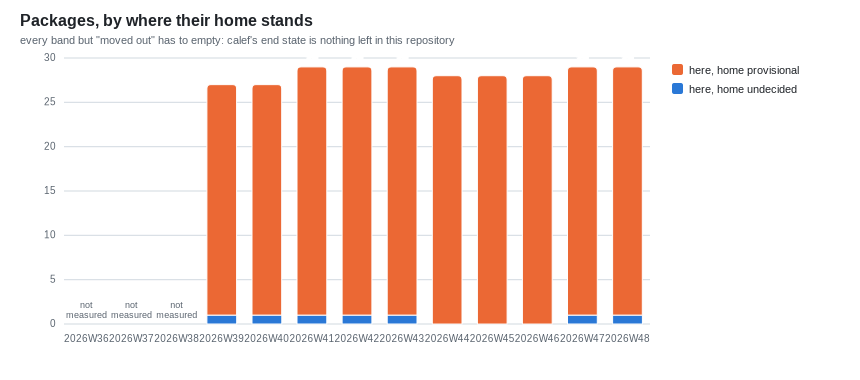
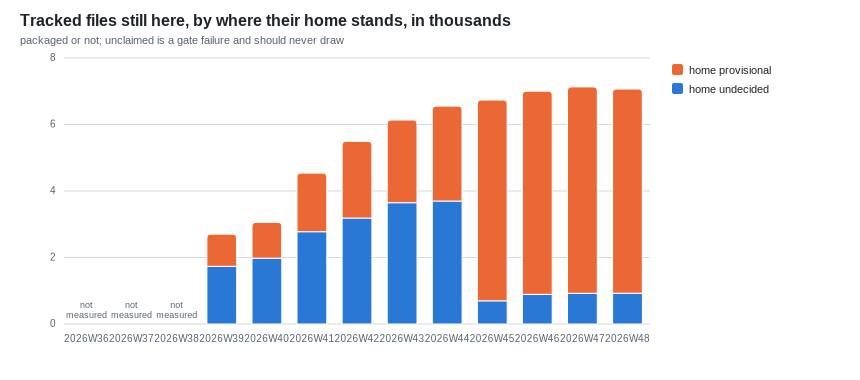
Homes
Unexplained benchmark drift on main
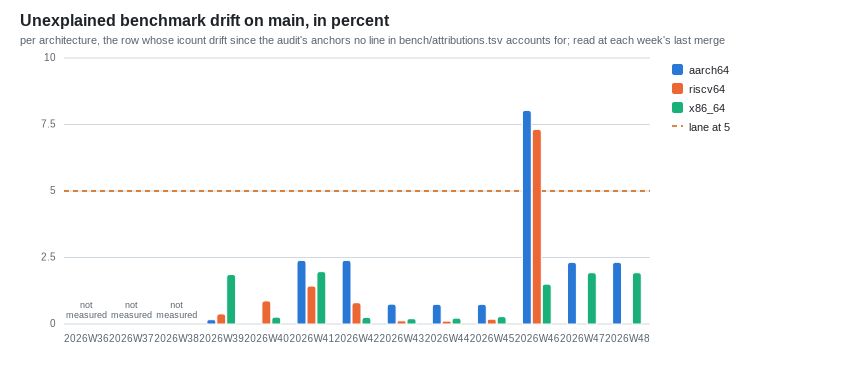
Drift since the anchors that no line in nifeos/nife:bench/attributions.tsv
accounts for, read at each week's last merge. Above 5% is a lane (calef, 2026-10-22). Every row,
save and reason: the drift report (nifeos/nife:notes/project-metrics/baseline-drift.md).
2026W48, main at 995720623: nothing unexplained past 5%; the largest, aarch64 ipc_rtt_el0 +2.32%, riscv64 sink_throughput -2.80%, x86_64 call_reply +1.93%.
Interface stability
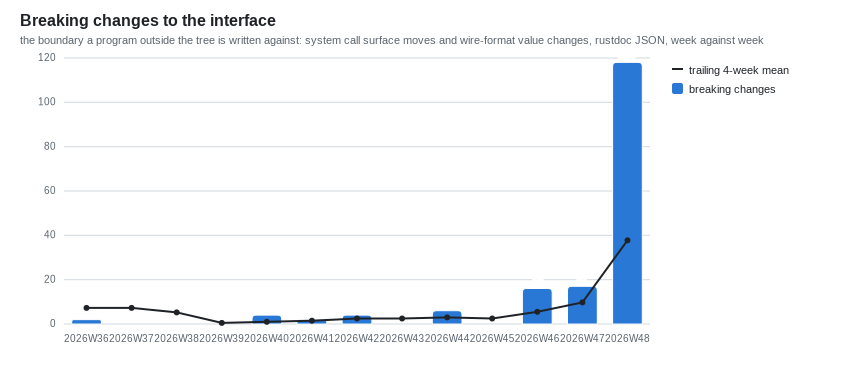
The boundary a program outside the tree is written against, each week: system call surface moves
and wire-format value changes. definitions,
per crate and package (nifeos/nife:notes/project-metrics/interface-stability.md).
interface, 2026W45 to 2026W48: 151 breaking changes (33 additions); 119 system call numbers changed, 0 format bumps; 49% co-change, 51% across packages.
The crates 857 releases
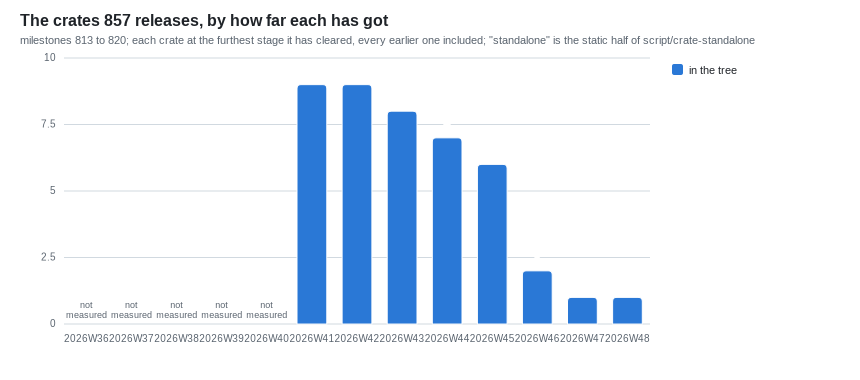
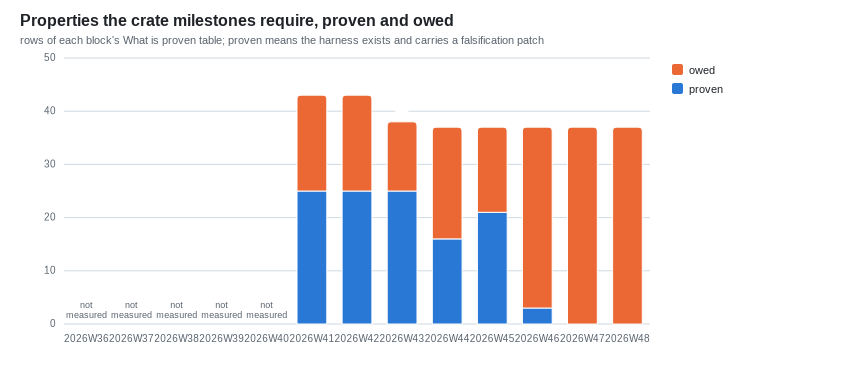
Milestones 813 to 821; all nine crates start in the tree. Both charts read git alone
(helpers/crate_release.py).
Kani proof harnesses, and what can falsify them
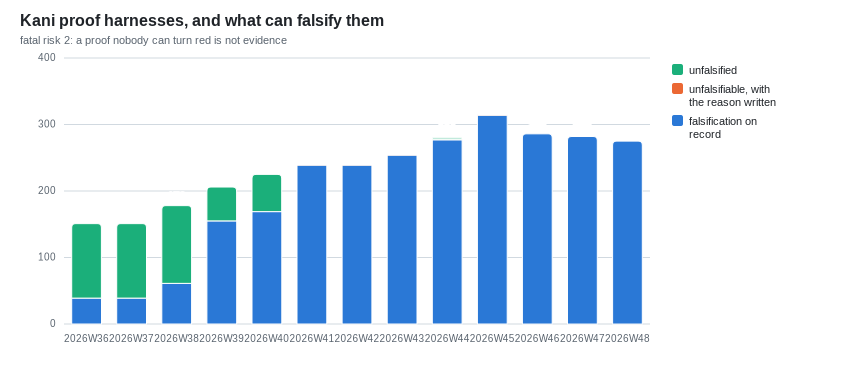
- 2026W41: unfalsified fell 56 to 0 across #1697, #1701 and #1713; the middle band is new (§134 (a harness carries a machine-replayable falsification record, or it is not evidence), amended 2026-10-06 UTC). Its two harnesses were examined and no defect in today's code can turn them red; each carries its reason.
A harness with no falsification record at all counts as unfalsified. The denominator is harnesses, not code: unharnessed code is outside it (what each ratio is of).
Action items the corrections of error still owe
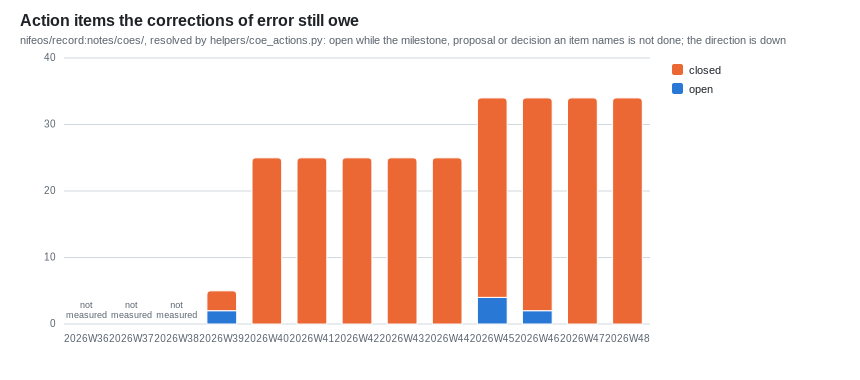
- 2026W40: open items fell 3 to 0 on 2026-10-04 UTC. Milestone 641 (a mechanism that reports clean), 725 (count every vendor) and 640 (a gate is not evidence) turned BUILT.
Open while what an item names is not done; the direction is down (script/roadmap --coe-actions).
Each week is read from its own commit, so 2026W39 is the first correction, already in this form.
Passive voice
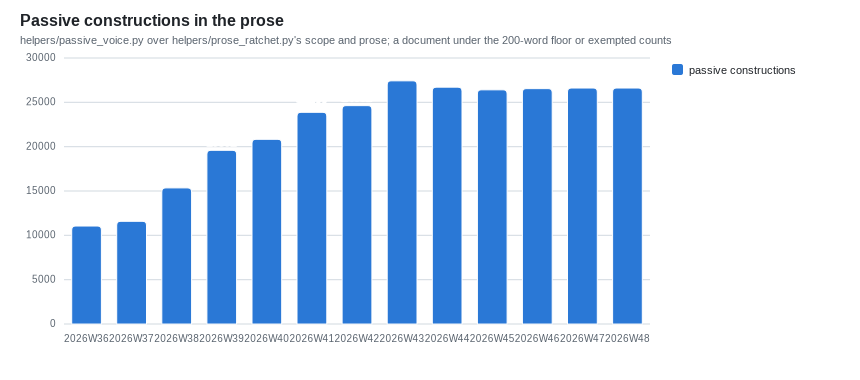
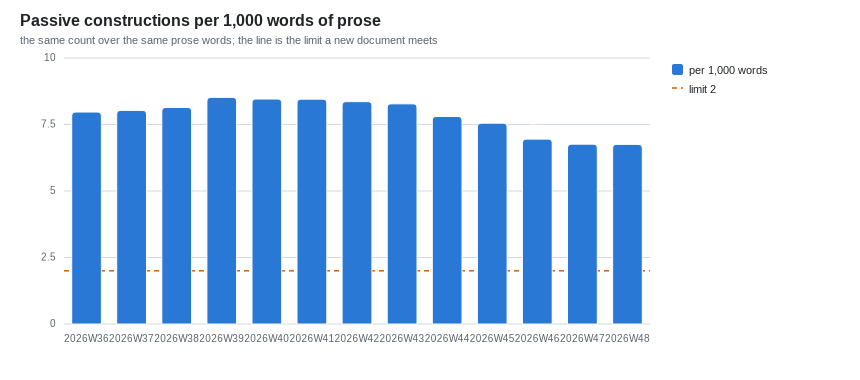
§213 (writing standards) rule 6's count over the prose ratchet's documents, then per 1,000 words of prose. The line is the limit a new document meets (definitions).
Repeated sentences
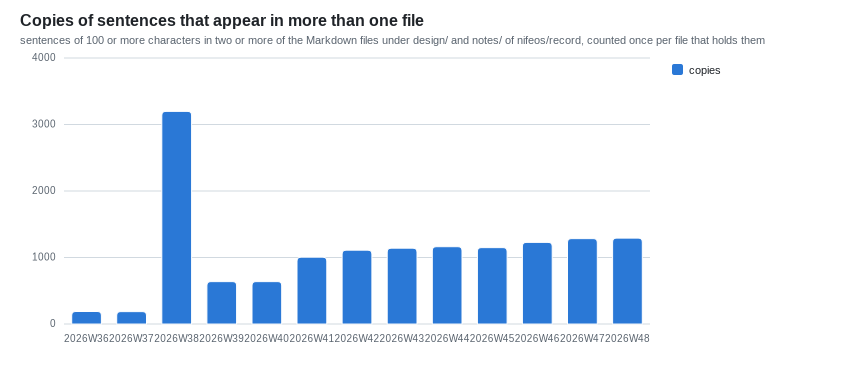
Copies of the sentences of 100 or more characters that appear in two or more Markdown files under design/ and notes/, each week of this repository's history. The 2026W38 spike was the roadmap index that a script wrote, which the record dropped on 2026-09-22.
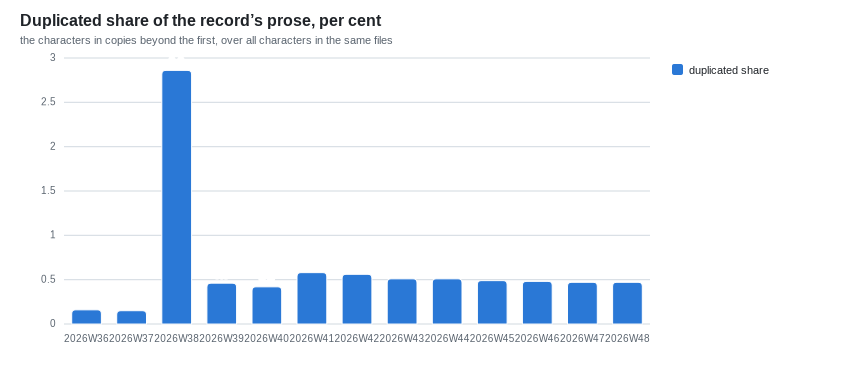
The share of the record's characters that make up those repeated sentences, by the same rule as the repeated-sentence lint (helpers/repeated_sentences.py). The 2026W38 peak is the same roadmap index.
Line-number citations
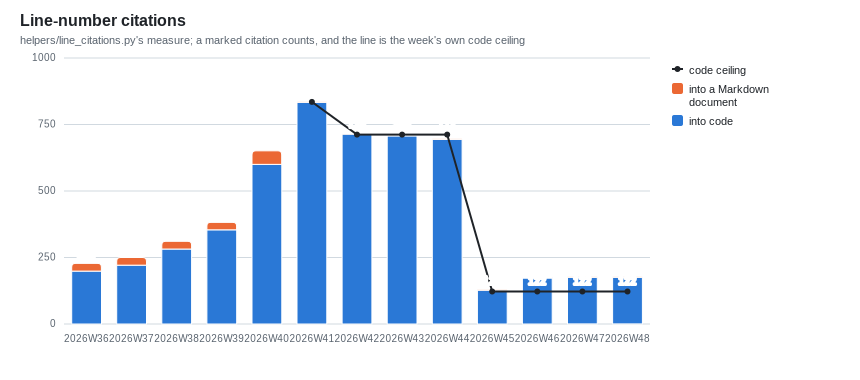
Citations by line number, which §277 (cite a heading or a symbol, never a line number) retires. The line is the code ceiling. Markdown is held at zero, so what remains there carries an exception marker.
How it stays current
.github/workflows/metrics.yml runs script/metrics --update daily and opens or refreshes a pull
request if anything changed. Two columns need a build: coverage, taken on Mondays (UTC), and the
interface series, from helpers/interface_stability.py. The cost columns come from session records on one laptop, never a workflow. How the series stays
current has the
rest.
BUGS
The series' known limitations are in project-metrics/limitations.md (nifeos/nife:notes/project-metrics/limitations.md).
- The paragraph under "Interface stability" predates the 2026-10-28 policy (accommodate change rather than wait for a lull; the four-week-zero reading is a reported interpretation that gates nothing). Its prose still frames stability as a state the tree reaches. Folding the wording waits for the next weekly metrics run or a small lane.
Architecture decisions by status
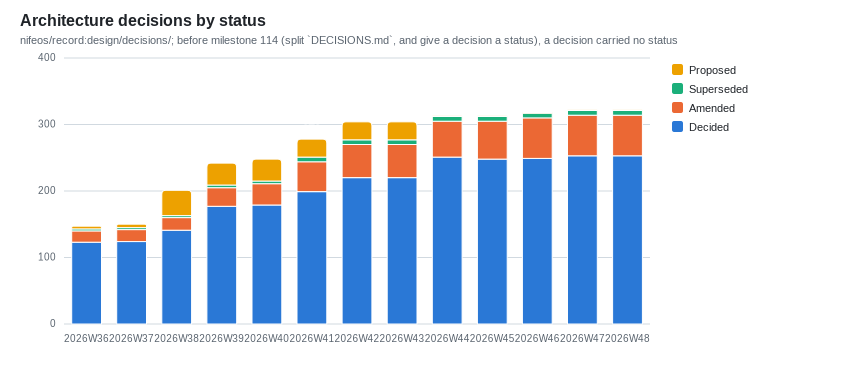
From design/decisions/. The gray band in the first three weeks is decisions that predate
a status existing at all, counted as having none rather than as DECIDED.